




You can usually spot ChatGPT writing in about four seconds. The tidy rule-of-three, the “it’s not just X — it’s Y,” the paragraphs that all run the same comfortable length. If you publish that text, your readers spot it too, and they trust it a little less each time. This article shows you exactly how to make ChatGPT sound less like AI using the prompt tweaks and editing passes I use on real client work — not vague “just add personality” advice.
From the series: everything in this article — and the nine books around it — lives in The Complete No-Hype Guide to Claude. 10 books, 693 pages, 450+ tested prompts, $47. See the library →

To make ChatGPT sound less like AI, give it a sample of real human writing to copy, ban its signature phrases (“delve,” “it’s important to note,” the rule-of-three), and tell it to vary sentence length hard. Then edit the draft: cut the throat-clearing opening sentences, drop in concrete specifics, and break the uniform rhythm. The fix is half prompt, half edit. It is never a single click, and any tool that promises otherwise is selling you something.
Key Takeaways
- The “AI tells” are mostly structural — predictable rhythm, the rule-of-three, constant hedging — not vocabulary alone, so swapping a few words barely moves the needle.
- The single highest-leverage move is pasting 150–300 words of your own writing and telling ChatGPT to match that voice exactly, before it writes a word.
- Sentence-length variation is the thing human writing has and default AI writing lacks; you have to demand it explicitly because the model won’t do it on its own.
- A two-minute editing pass that deletes the first sentence of most paragraphs removes the most obvious robotic pattern instantly.
- Sounding human and beating an AI detector are two different goals, and chasing detectors usually makes your writing worse, not better.
- Custom instructions and Projects let you store your voice once, so you stop re-explaining it in every new chat.
What Actually Makes ChatGPT Sound Like AI
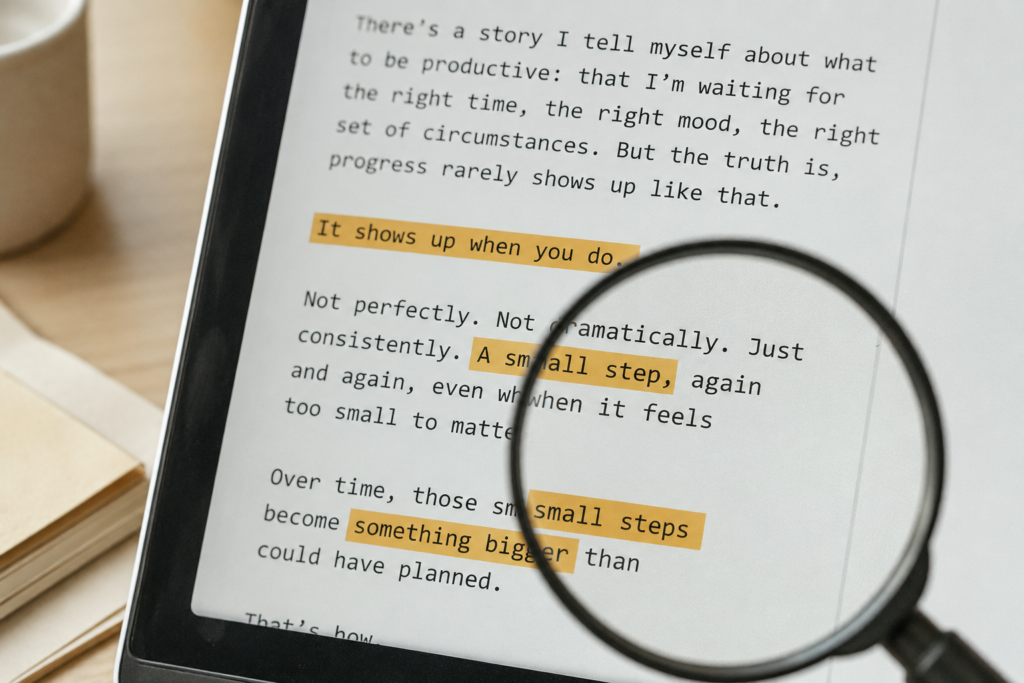
Before you can fix the sound, you need to hear it, and most people are listening for the wrong thing. They think it’s the words — “delve,” “tapestry,” “navigate the landscape.” Those are real tells, but they’re the easy ones, and ChatGPT has quietly dropped many of them since the GPT-5 family shipped. The deeper giveaways are structural, and structure is what your reader’s brain registers before any individual word.
Ten books. The whole craft. Zero hype.
From first chat to shipped product — 693 pages, 450+ tested prompts, $47 complete.
Open the libraryHere are the patterns that actually scream machine.
The rule-of-three. AI writing loves lists of three. “Clear, concise, and compelling.” “Strategy, execution, and measurement.” One tricolon is fine. Six in a 900-word post is a fingerprint. Real writers reach for two items, or four, or an awkward five — because they’re thinking about the idea, not the cadence.

The “it’s not just X, it’s Y” reversal. “ChatGPT isn’t just a chatbot — it’s a thinking partner.” This construction shows up constantly because the model uses it to manufacture a sense of insight. It reads as profound and says almost nothing.
Low burstiness. Burstiness is the variation in sentence length across a paragraph — the technical term for how much your rhythm jumps around. Human writing is bursty. A four-word sentence slams into a thirty-word one. Default ChatGPT output sits at a steady 15–20 words per sentence, paragraph after paragraph, like a metronome. That evenness is the most reliable AI tell there is, and it’s the one humanizer tools fail to fix.
Compulsive hedging. “It’s important to note.” “While there are many factors to consider.” “However, it’s essential to remember.” The model was trained to sound balanced and inoffensive, so it qualifies everything. People with actual opinions don’t.
Hollow transitions. “Furthermore.” “Moreover.” “Additionally.” Stacked Latinate connectors that add zero meaning. A human writer just starts the next sentence.
The conclusion that restates. AI endings summarize what you already read instead of pushing forward. You’ll see “In summary” or a paragraph that lists the three points again. Nobody who cares about the reader does that.
Notice what all of these have in common: none of them are about being wrong. The information can be perfect. The problem is that the writing has no friction, no opinion, no specific human who clearly wrote it. That flatness is the sound you’re trying to kill.
How to Make ChatGPT Sound Less Like AI With Better Prompts
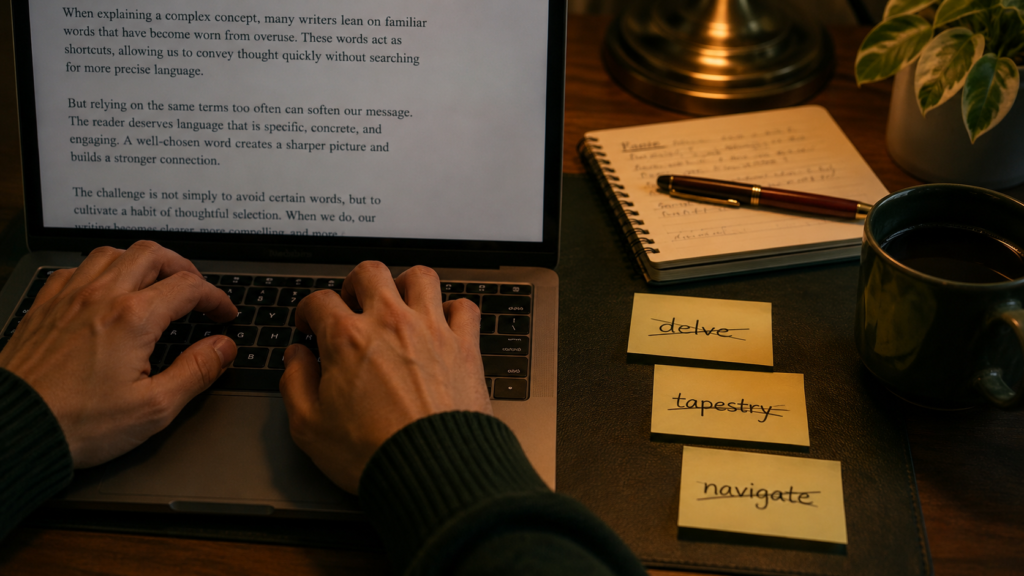
The cheapest, fastest improvement happens before generation, in the prompt itself — and most people skip it entirely. They type “write a blog post about X” and then wonder why it reads like every other blog post about X. A good prompt constrains the model away from its defaults, and four constraints do most of the work.
Ten books. The whole craft. Zero hype.
From first chat to shipped product — 693 pages, 450+ tested prompts, $47 complete.
Open the libraryGive it a voice to copy. This is the big one. Paste 150–300 words of writing you like — yours, ideally — and tell ChatGPT: “Match the voice, rhythm, and sentence variety of this sample. Do not match its topic.” The model is excellent at imitation and mediocre at inventing a voice from nothing. Hand it a target and it stops defaulting to corporate-blog beige.
Ban its tics by name. Add a literal blocklist: “Do not use the words delve, tapestry, navigate, landscape, realm, testament, or the phrase ‘it’s important to note.’ Do not use more than one list of three in the whole piece. Do not start sentences with Furthermore, Moreover, or Additionally.” Specific bans work. “Sound natural” does not.
Force sentence variation. Tell it: “Vary sentence length aggressively. Include several sentences under five words. Include at least two sentences over thirty words. No two consecutive sentences should be the same length.” This single instruction does more for the human feel than any vocabulary change, because it attacks the low-burstiness tell directly.
Demand specifics and a point of view. “Use concrete numbers, real product names, and dated examples. Take a clear position — do not present a balanced overview.” Hedging dies when you forbid it. Vagueness dies when you require detail.
Here’s a compact version you can paste today:
Write in the voice of the sample below — match its rhythm and sentence variety, not its topic. Vary sentence length hard: some under five words, some over thirty. Take a clear position. Use specific numbers and real examples. Banned: delve, tapestry, navigate, realm, “it’s important to note,” more than one rule-of-three, and the words Furthermore/Moreover/Additionally. [PASTE YOUR 200-WORD SAMPLE]
I ran a plain “write a 300-word intro about email marketing” prompt against that constrained version on GPT-5.5. The plain one used three tricolons and opened two paragraphs with “In the world of.” The constrained one opened with a four-word sentence and named a specific open-rate number. Same model. Same minute. The only difference was the instructions.
The Editing Pass That Strips the Robot Out
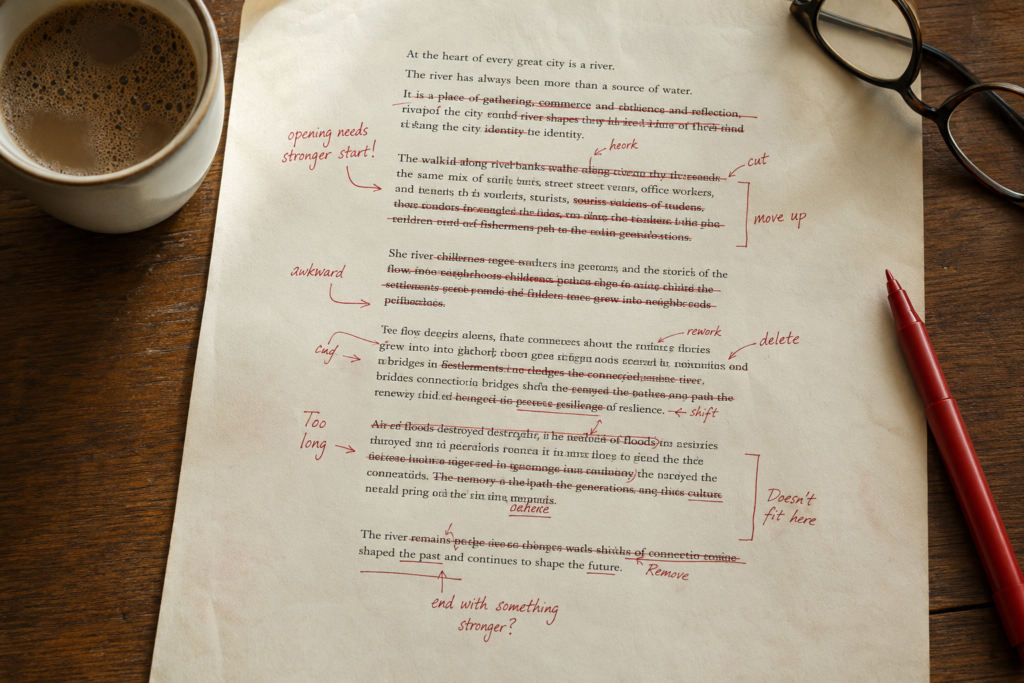
No prompt gets you all the way there, so the second half of the job is a fast edit, and you can do it in under three minutes once you know what to cut. Think of it as scrubbing fingerprints, not rewriting.

"Every prompt was run before it was printed. If a claim couldn't be tested, it didn't make the book." The No-Hype Guide to Claude — all 10 books →
Cut the first sentence of most paragraphs. AI loves to clear its throat. “When it comes to X, there are several things to consider.” Delete it. The real point is almost always in sentence two. This one habit removes more robot than anything else on this list.
Break or kill the tricolons. Search the draft for any list of three. Keep one if it earns its place. Turn the rest into two items, or four, or just a plain sentence. The rhythm change is immediate.
Add one concrete detail per section. A number, a name, a date, a tiny real anecdote. “It improves engagement” becomes “it lifted our newsletter opens from 22% to 31% over six weeks.” Specificity is the texture AI can’t fake and the thing readers actually remember.
Smash the rhythm. Find three consecutive medium sentences and rewrite one as a fragment. Two words. Like that. The eye relaxes when the rhythm moves.
Read it aloud. This sounds soft but it’s the most reliable test there is. Your ear catches the metronome cadence your eye skims past. Anywhere you sound like you’re reading a press release, mark it and fix it.
Here’s the pass in action. ChatGPT gave me this: “When it comes to building an email list, there are several strategies to consider. Offering a valuable lead magnet, optimizing your signup forms, and promoting across channels can all help grow your audience effectively.” Two medium sentences, throat-clearing open, tricolon close — textbook AI. Thirty seconds of editing later: “Most email lists die from one mistake — asking for the signup before giving a reason to. Fix the reason first. A lead magnet someone actually wants beats a prettier form every time.” Same facts. I cut the setup sentence, broke the rule-of-three, dropped in a real opinion, and let the rhythm jump from twelve words to three. That’s the entire job, repeated section by section.
A quick honesty note, since this is an anti-hype site: I write with em dashes constantly, and so does ChatGPT. The em dash alone is not an AI tell — plenty of human writers lean on it. What flags as machine is uniform em-dash use as a rhythm crutch in every paragraph. Variety is the signal. Don’t let anyone scare you off your own punctuation.Prompting vs Editing vs Humanizer ToolsA quick honesty note, since this is an anti-hype site: I write with em dashes constantly, and so does ChatGPT. The em dash alone is not an AI tell — plenty of human writers lean on it. What flags as machine is uniform em-dash use as a rhythm crutch in every paragraph. Variety is the signal. Don’t let anyone scare you off your own punctuation.
How to Make ChatGPT Sound Less Like AI by Feeding It Your Voice Permanently
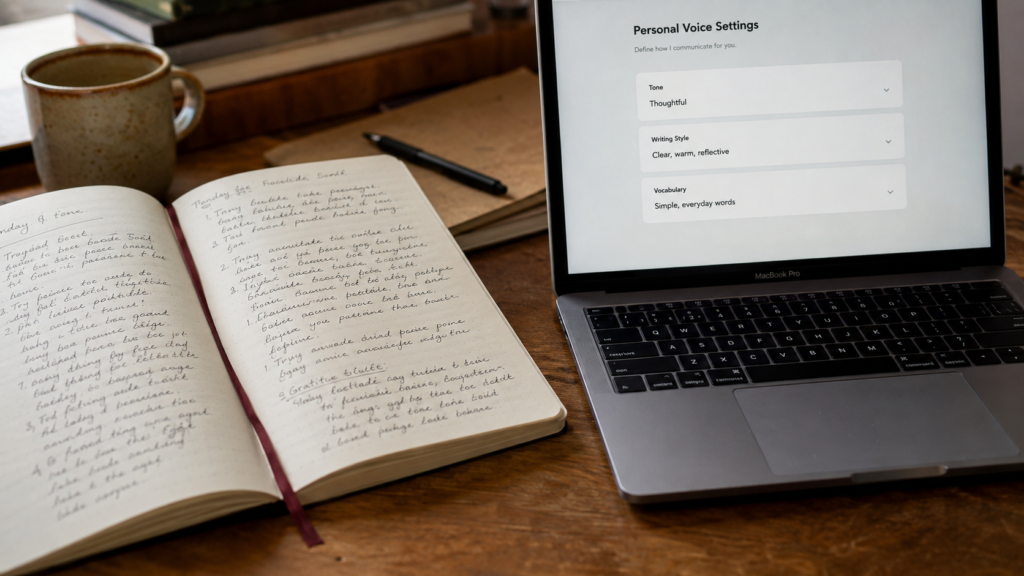
If you write with ChatGPT more than once a week, re-pasting your voice sample every session is a waste, and the platform now gives you three places to store it. Set this up once and every draft starts closer to your real sound.
Custom instructions. In ChatGPT’s settings, the “How would you like ChatGPT to respond?” box applies to every chat. Put your hard rules there: your banned-word list, your sentence-variation instruction, your “take a position, don’t hedge” rule. It runs silently in the background forever. This is the most underused feature in the product, and it costs you ten minutes to fill out.
Projects. For a specific publication or client, create a Project and upload two or three of your best published pieces as reference files, plus a short style note. Every chat inside that Project inherits the voice. I keep one Project per brand I write for, and the difference in first-draft quality is the difference between editing for three minutes and rewriting for thirty.
A reference doc you paste. Lower-tech but portable across any model — Claude, Gemini, DeepSeek — is a single “voice guide” document: 200 words of sample, your banned list, three before-and-after rewrites showing the model what you mean. Paste it at the top of any chat and you’re calibrated in seconds.
The reason this works is mechanical. ChatGPT predicts the next word based on everything in front of it. Fill that context with your patterns and it predicts in your direction. Fill it with nothing and it predicts toward the statistical center of the internet — which is exactly the flat, average voice you’re trying to escape.
Prompting vs Editing vs Humanizer Tools: What Actually Works
Most people Googling this end up on a “humanizer” tool, so it’s worth being blunt about where each approach actually lands. Here’s how the four real options compare.
| Approach | Effort | Reliability | Cost | Best for |
|---|---|---|---|---|
| Better prompting | Low (once learned) | High | Free | Every draft, every time — your first line of defense |
| Manual editing pass | Low–medium | Highest | Free | Anything you actually publish under your name |
| Style samples + Projects | Medium setup, then low | High | Free | Anyone writing regularly for the same brand |
| Humanizer / “undetector” tools | Very low | Low–medium | $10–30/mo | Almost nothing — see below |
The humanizer tools deserve a real warning. They work by swapping synonyms and shuffling sentence structure to fool detectors, and they routinely make writing worse — odd word choices, mangled idioms, sentences that technically pass a detector but read like a thesaurus had a seizure. They’re solving for the wrong target.
That target is the bigger trap. “Sound human” and “beat an AI detector” are not the same goal. AI detectors are unreliable — a 2023 Stanford study found that popular GPT detectors flagged genuine essays by non-native English writers as AI-generated more than half the time, a bias that has real consequences for real people. Google has said plainly that it rewards helpful content regardless of how it’s produced, and penalizes unhelpful content the same way. So chasing a detector score optimizes for a number nobody important is actually checking, while you ignore the thing readers and search engines both reward: writing that’s specific, opinionated, and useful. Spend the effort there.
Common Mistakes That Keep ChatGPT Sounding Robotic

Even people who know the basics keep tripping on the same four things, and each one is the kind of mistake that feels like progress while it quietly does nothing.
Editing the words but not the structure. You swap “delve” for “explore” and call it done. But the rule-of-three is still there, the rhythm is still flat, and every paragraph still opens with a setup sentence. Vocabulary is the surface. If you only fix the surface, the text still reads as AI to anyone paying attention. Fix the structure first; words second.
Giving the model a personality instead of a voice. “Write like a witty, energetic expert” produces a caricature — forced jokes, exclamation points, fake enthusiasm. That reads more artificial, not less. Don’t describe a personality. Show a sample. Imitation of real text beats description of a vibe every time.
Trusting an AI detector to grade your work. People paste their edited draft into a detector, see “85% AI,” panic, and run it through a humanizer that wrecks it. The detector was probably wrong — false positives are rampant — and now you’ve degraded good writing chasing a meaningless score. Use your own ear and a human reader, not a detector, as the final check.
Over-correcting into chaos. The opposite failure. Someone reads “vary your sentences” and produces a jumpy mess of fragments with no flow, or stuffs in so many “casual” asides that the point disappears. Human writing varies, but it still has a spine. The goal is rhythm, not randomness. Read it aloud — if you run out of breath or lose the thread, you went too far.
Frequently Asked Questions
Why does ChatGPT always sound the same no matter what I ask? Because without specific instructions, it writes toward the statistical average of its training data — the “center” of how the internet writes. That center is a smooth, hedged, list-friendly voice. The fix is to give it a target: paste a writing sample to copy, ban its default phrases, and force sentence variation. Constrain it and the sameness breaks.
Can ChatGPT actually write in my personal voice? Yes, and better than most people expect. Give it 200–300 words of your real writing and tell it to match the rhythm and word choices, not the topic. The model is strong at imitation. For ongoing work, store a few samples in a ChatGPT Project so every draft starts in your voice instead of the generic default.
Do AI humanizer tools really work? Not well. They swap synonyms and reshuffle sentences to trick detectors, which often makes the writing read stranger, not more natural. They also chase the wrong goal — fooling a detector instead of serving a reader. A solid prompt plus a three-minute manual edit beats any humanizer tool, costs nothing, and won’t mangle your sentences.
Will Google penalize content written with ChatGPT? Google has stated it judges content on helpfulness and quality, not on whether AI was involved. Thin, generic AI text gets demoted — but so does thin, generic human text. Well-edited, specific, genuinely useful content ranks regardless of how it was drafted. Focus on adding real value, not on hiding the tool.
What words should I tell ChatGPT to avoid? Start with delve, tapestry, navigate, landscape, realm, testament, and the phrases “it’s important to note” and “in today’s world.” Then ban structural habits: no more than one rule-of-three, and no sentences starting with Furthermore, Moreover, or Additionally. The structural bans matter more than the vocabulary ones, because rhythm is what gives the machine away.
How do I make ChatGPT writing pass an AI detector? Honestly, stop optimizing for that. Detectors are unreliable and frequently flag real human writing, especially from non-native English speakers. Chasing a detector score usually degrades your writing. Instead, make the text genuinely good — specific, opinionated, varied in rhythm — and let the detector say whatever it wants. Readers and search engines reward quality, not detector scores.
The One Thing to Remember
If you take a single idea from this, make it this one: the robot sound is structural, not lexical, so learning how to make ChatGPT sound less like AI is really about fixing rhythm, specificity, and point of view — not hunting for fancier words. Set up your voice once in custom instructions, run the three-minute edit on anything you publish, and ignore the detectors entirely. The next time you open a blank chat, paste your voice in first — and watch how much less editing the draft needs.
Enjoyed this? Steal the 10 prompts I actually use.
The No-Hype AI Starter Kit — copy-paste prompts, a model cheat-sheet, and a 7-day plan. Drop your email and it's yours instantly.
No spam. Unsubscribe anytime.