



AI Without the Hype · Money & Life Admin
A step-by-step way to use AI to translate the paperwork, draft the script, and actually ask for less before you pay anything.

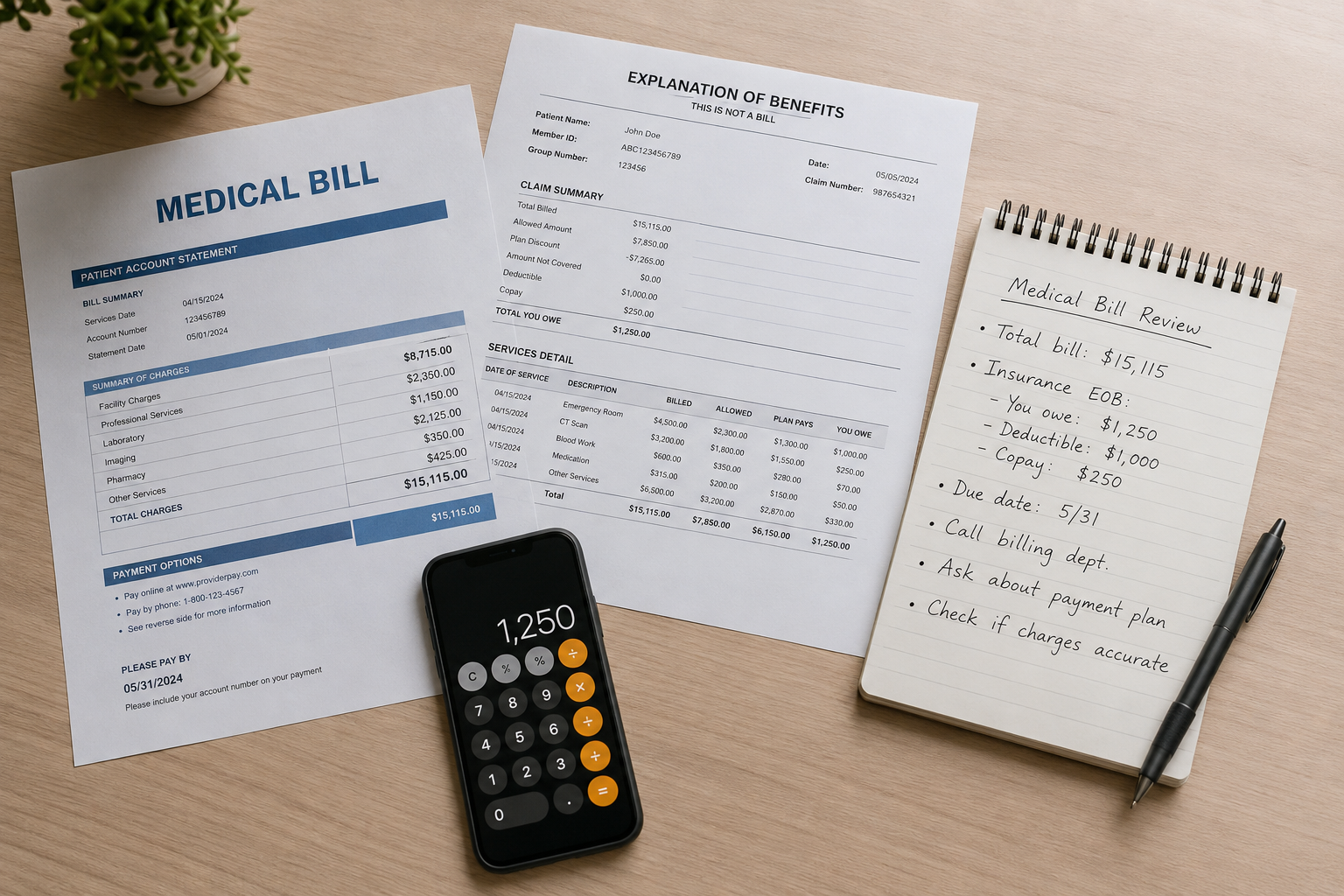
A four-figure hospital bill lands in your mailbox, and the letter inside reads like it was designed to be ignored — a summary total, a due date, no explanation of what any of it actually means. You know somewhere in that stack of paperwork is a number you shouldn’t have to pay in full, but you don’t know how to say that out loud to a billing office. This is where it actually helps to negotiate a medical bill with AI: not as some magic fix, but as the thing that turns confusing paperwork into a script you can read off a phone call. By the end of this, you’ll have the exact prompts, the letter template, and the order to do things in before you pay anything.

"Every prompt was run before it was printed. If a claim couldn't be tested, it didn't make the book." The No-Hype Guide to Claude — all 10 books →
You can negotiate a medical bill with AI by using it to translate your itemized bill and insurance statement into plain language, then draft a specific, numbers-backed script or letter for the billing department. AI can’t call the hospital for you and it can’t verify medical facts, so you still gather the real bill, the real insurance paperwork, and your own financial details first. Used that way, people commonly get bills reduced through cash-pay discounts, corrected billing errors, or hospital charity care.
Key Takeaways
- Request an itemized bill in writing before you do anything else. Providers are required to give you one, and billing errors show up in the line items, not the summary total.
- AI is best used to translate your Explanation of Benefits and draft your negotiation script — not to verify medical codes or place the call for you.
- Nonprofit hospitals, which make up roughly 60% of U.S. hospitals, are legally required to offer charity care, and you can apply even after a bill has gone to collections.
- Offering to pay a lump sum in cash commonly gets a 15% to 20% “prompt-pay” discount, according to medical billing advocates.
- A specific, personalized hardship letter beats a generic template every time, and AI’s real value is turning your rough notes into something that reads that way.
- Keep every response in writing where you can, and if you do call, write down who you spoke to and what they agreed to.
Why You Can Negotiate a Medical Bill (And Why Most People Don’t Bother)
Here’s the part almost nobody tells you: the number on a hospital bill is rarely a fixed price. It’s usually pulled from something called a chargemaster, an internal list of sticker prices that almost nobody actually pays in full. Insurance companies negotiate steep discounts off that list every day. So do Medicare and Medicaid. The only people routinely asked to pay the full chargemaster rate are the uninsured and the underinsured — which is exactly backwards, since they’re also the people least able to absorb it.
Ten books. The whole craft. Zero hype.
From first chat to shipped product — 693 pages, 450+ tested prompts, $47 complete.
Open the libraryMedical billing advocates back this up publicly. Consumer Reports has quoted Adria Gross, founder of MedWise Insurance Advocacy, saying plenty of providers are willing to negotiate once a patient asks, because billing staff understand why people push back on a large bill. Abbie Leibowitz, chief medical officer at Health Advocate Solutions, has made a similar point: when a charge isn’t covered by insurance, there’s genuine room to discuss the fee and ask for a discount off the posted rate. None of this is some closely held secret. It’s just rarely offered upfront, because there’s no financial incentive for a billing office to volunteer a discount nobody asked for.
The financial pressure behind all this is well documented, not anecdotal. A Kaiser Family Foundation survey cited by Consumer Reports found that 20% of people 65 and older struggle to pay medical bills, as do 30% of working adults who already have health insurance, and nearly half of Americans said they’d have trouble covering an unexpected $500 medical bill. A separate, nationally representative Consumer Reports survey of 2,200 adults found that 30% of privately insured Americans had received a bill where insurance covered less than they expected going in. This isn’t a fringe problem you ran into through bad luck. It’s the default experience for a huge share of patients, which is exactly why negotiating isn’t rude, or unusual, or a sign you can’t afford care. It’s just something almost nobody was ever taught how to do, in the same way nobody teaches you how to actually read an EOB until you’re forced to.

of U.S. hospitals are nonprofit and legally required to offer charity care
typical “prompt-pay” discount for a lump-sum cash offer
the usual minimum window to apply for hospital charity care
Where AI actually fits into all this is narrower than most people assume, and it’s worth being honest about the edges. It won’t discover a discount that doesn’t exist, and it can’t confirm whether a procedure code was billed correctly — that’s a job for the itemized bill, and sometimes a human billing advocate. What it’s genuinely good at is turning your specific numbers and situation into a clear, professional script fast, so you’re not staring at a blank page trying to figure out how to open the conversation. It’s really the same instinct behind using AI to find money you’re already leaving on the table, just pointed at money going out instead of money coming in.
The 5-Minute Prep That Makes Any AI Prompt Actually Work
Skip this step and every AI draft you get back will sound like a form letter, because it basically will be one — generic phrasing standing in for facts nobody gave it. Spend five minutes gathering the following before you open a chat window, and the difference in what comes back is immediate.
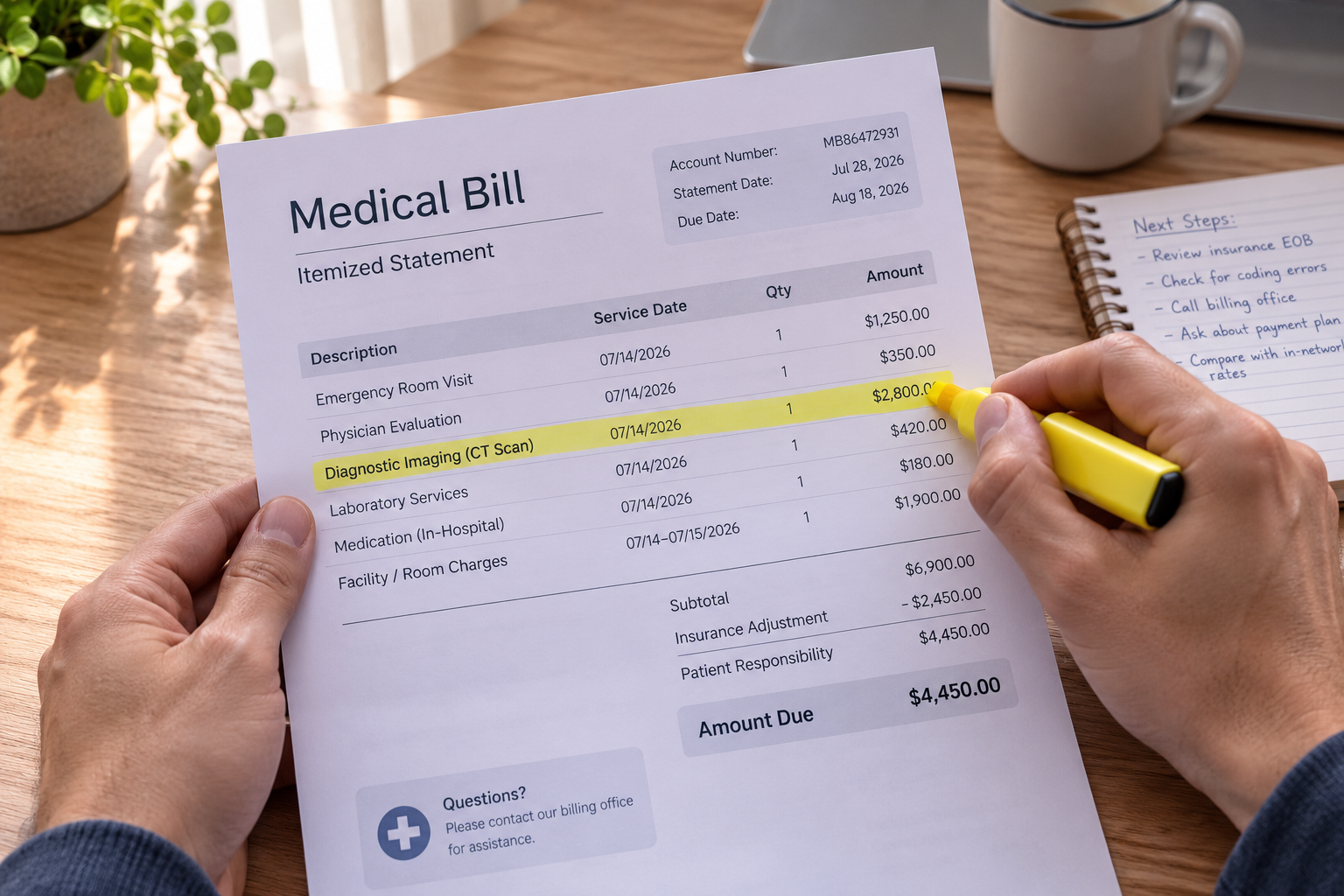
The itemized bill
Not the one-page summary — the full line-by-line breakdown. If you only have the summary, call or email the billing office and ask for it in writing. This is a real right, not a favor. Federal rules tied to the No Surprises Act, along with HIPAA’s right of access to your own billing records, generally require providers to produce documentation like this within a set window after you request it.
Your Explanation of Benefits (EOB)
If you have insurance, this is the document showing what was billed, what they allowed, what they paid, and what’s left over — the line usually labeled “patient responsibility.”
Your own numbers
Household income, whether you’re covered by insurance, and roughly what you can actually pay right now versus over a few months. You don’t need exact figures for AI, but you do need real ones — vague inputs produce vague, unusable drafts.
The provider’s contact details
The billing department’s direct phone line and any online patient portal, since you’ll want a paper trail either way this goes.
Once you have those four things in front of you, open a fresh AI chat instead of reusing an old conversation thread about something unrelated. Starting clean keeps the model focused on your numbers instead of pulling in context that has nothing to do with your bill.
You don’t need a paid subscription for any of this. A free-tier account on a major AI tool handles this entire workflow fine — the drafting here is short-form writing, not a task that needs a premium model. If you’re not sure which free tool to start with, our rundown of free AI writing tools covers the practical differences — file upload limits, chat memory, how each one handles a pasted document — so you’re not guessing mid-task.
The Exact AI Prompt to Negotiate a Medical Bill Like You’ve Done It Before
This is the prompt to copy, fill in your own details in the brackets, and paste as-is into Claude, ChatGPT, or whichever AI tool you already have open:
Copy-Paste Prompt
“I received a medical bill from [provider name] for [total amount]. Here’s what’s on the itemized bill: [paste the line items]. My insurance [does / doesn’t] cover this, and here’s what the EOB shows: [paste relevant lines, or write ‘no insurance’]. My situation: [one or two honest sentences — job loss, high deductible, fixed income, whatever’s true]. Write a short, direct, professional script I can read over the phone to the billing department, asking for [a prompt-pay discount if I pay X% today / a corrected bill because of the duplicate charge / a payment plan / a review for financial assistance]. Keep it under 150 words, confident but not aggressive, and give me one likely pushback they’ll raise and how I should respond to it.”
Claude in particular tends to produce a calmer, less salesy draft for writing like this than some alternatives do — we’ve written about why its tone reads that way if you’re curious what’s actually going on under the hood. Notice what’s doing the actual work in that prompt, though, regardless of which tool you use: real numbers, a specific ask, and a request for pushback in advance. That last part matters more than people expect. Leibowitz has pointed out that the first response from a billing rep is often a flat no, and getting anywhere usually means calmly asking for a supervisor, sometimes more than once, until you reach someone with real authority to make a deal. Knowing that going in means you won’t hang up defeated after the first “there’s nothing I can do on my end.”
If you’d rather have a written version to send by email or through a patient portal instead of reading a script out loud, just change the last line of the prompt to ask for “a short, polite email instead of a phone script.” Same inputs, different output format — that’s the whole trick to getting more mileage out of one solid prompt across different channels.
Free Download
The No-Hype AI Starter Kit
10 copy-paste prompts that actually save you time, a cheat-sheet for which AI tool to use for which job, and 3 rules that make any prompt you write twice as good — free, instant download.
Get the free Starter Kit →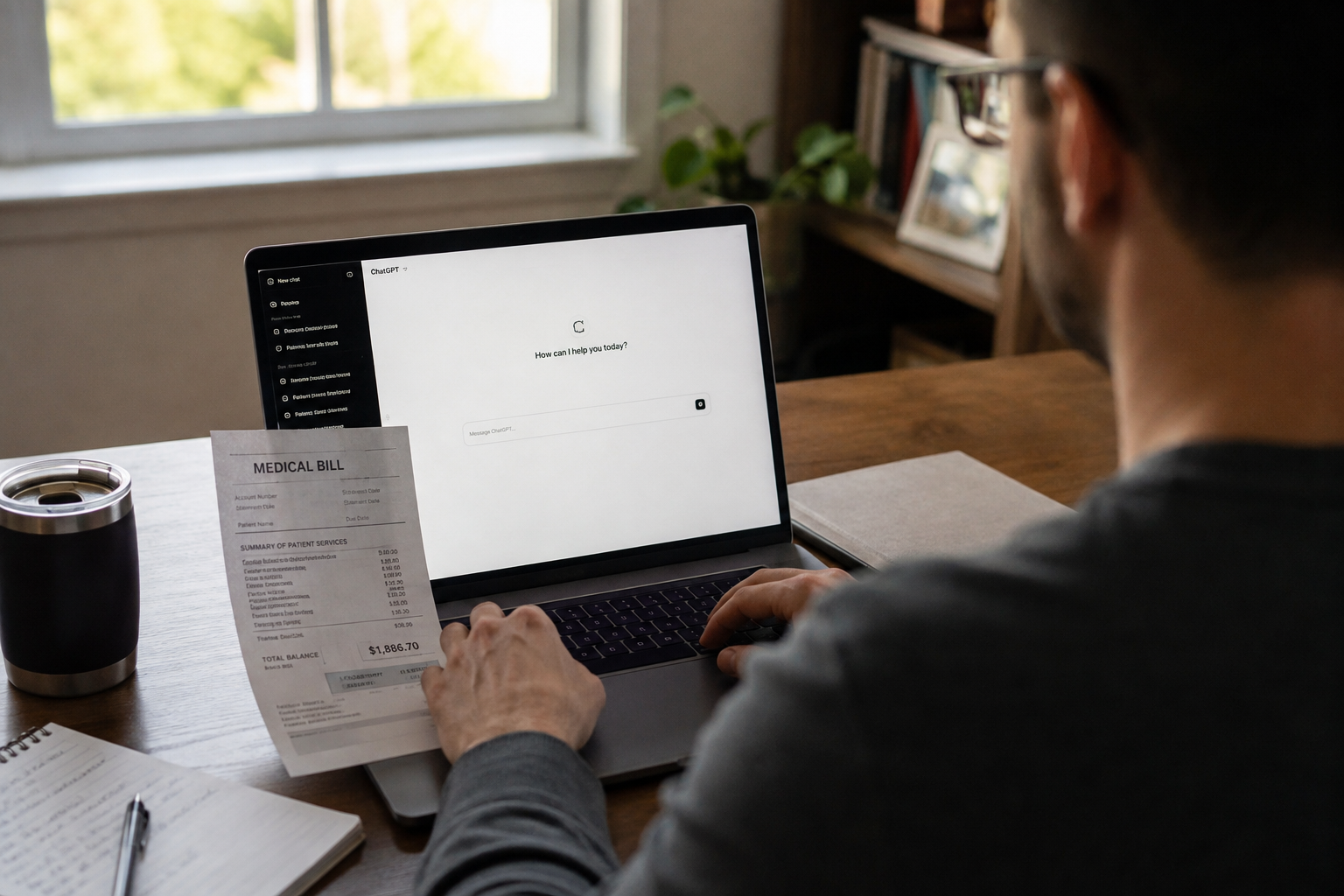
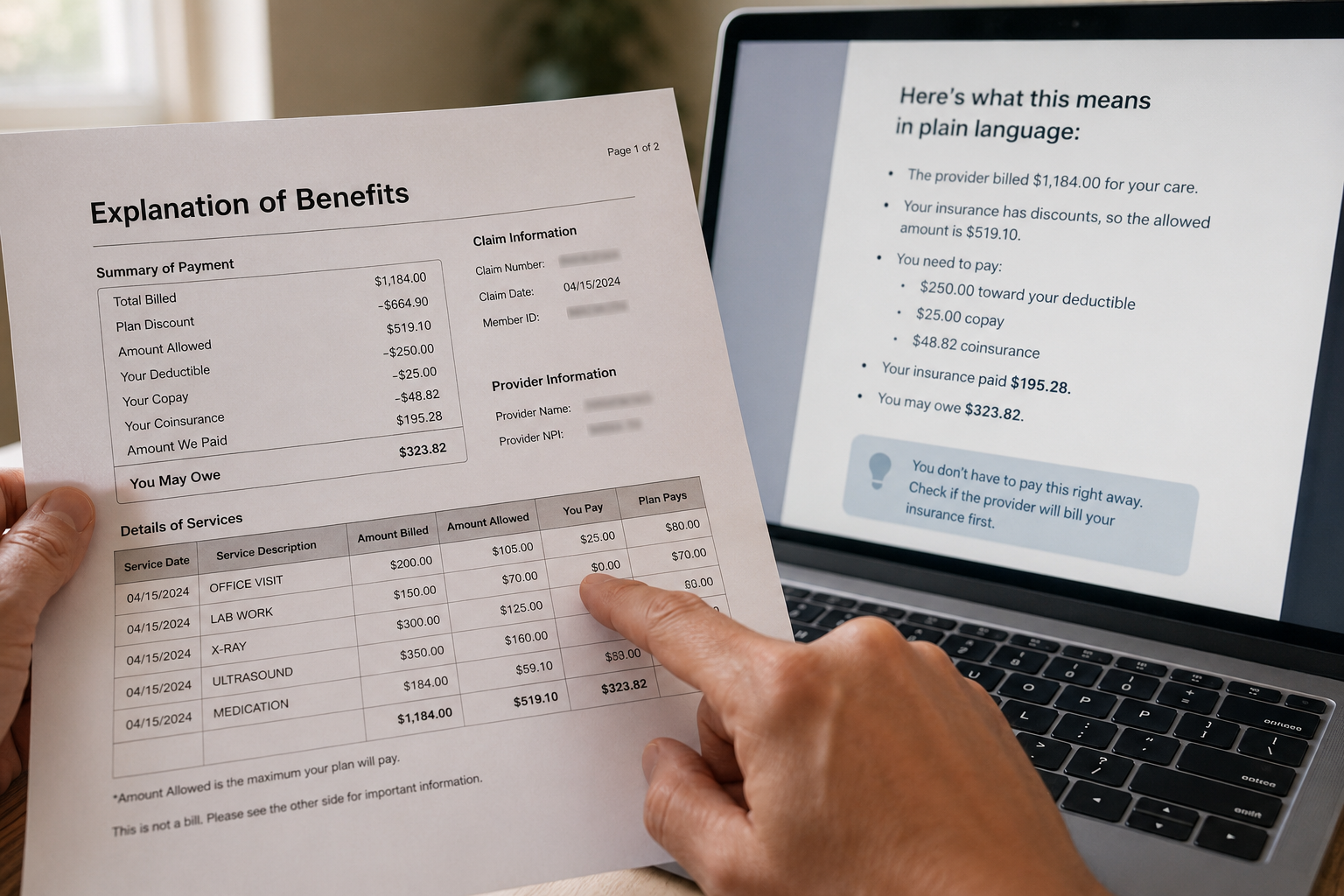
Turning Your EOB Into Plain English With AI (So You Know What You’re Disputing)
An Explanation of Benefits is written in a dialect all its own — “allowed amount,” “adjustment,” “coinsurance,” “patient responsibility” — and misreading even one of those terms can mean you quietly accept a charge you never should have owed. Before you draft anything else, ask AI to translate it line by line.
Copy-Paste Prompt
“Here’s my Explanation of Benefits: [paste it, or type out the key lines]. Explain in plain English what each amount means, especially the difference between what was billed, what my insurance allowed, what they paid, and what I supposedly still owe. Flag anything that looks like it could be a duplicate charge, an out-of-network surprise, or a simple math error between the lines.”
A few of these terms trip people up more than the rest, so it helps to know them before you even open the chat:
- Billed amount — the chargemaster sticker price the provider submitted, before any insurance discount is applied.
- Allowed amount — the discounted rate your insurer has already negotiated with that provider for the service.
- Adjustment (or “write-off”) — the gap between billed and allowed amounts that the provider agrees to absorb, meaning you should never owe this part.
- Patient responsibility — what’s actually left for you to pay after insurance processes the claim, which is the only number that should show up on your final bill.
If your bill’s total doesn’t line up with the “patient responsibility” line on your EOB, that mismatch alone is often enough to justify a call.
This step is also where a surprising amount of real savings hides. Rules tied to nonprofit hospitals’ tax-exempt status generally cap what patients who qualify for financial assistance can be charged, limiting it to roughly the same “amounts generally billed” to insured patients for the same service — a cap built specifically to stop uninsured or underinsured patients from getting stuck with inflated chargemaster prices nobody else actually pays. AI won’t know your specific hospital’s policy or whether that cap applied to your bill. What it can do is help you draft the exact question to send their financial counseling office asking precisely that, in language that sounds like you already know the rule exists.
“The number on your bill is a starting offer, not a verdict.”
The Hardship Letter Draft That Doesn’t Read Like a Form Letter
If your income is limited enough, you may not need to negotiate a discount at all — you may qualify to have some or all of the bill written off entirely through the hospital’s own charity care program. Federal tax law requires every nonprofit hospital to maintain a written financial assistance policy, and most base eligibility on the federal poverty level, with many offering completely free care at or below 200% of it and sliding-scale discounts extending up to roughly 400%. Hospitals generally give patients at least 240 days from their first billing statement to apply, and applications can be submitted even after a bill has already gone to collections.
Say, for example, a single parent working part-time hours with a $3,200 emergency room bill and no employer insurance. A household in that position often falls comfortably within a hospital’s free-care threshold, though every hospital’s policy differs and this is meant as an illustration of how the math can work, not a guarantee for any specific case. The right move there isn’t to negotiate that bill down piece by piece. It’s to apply for financial assistance directly and let the policy do the reducing.
Copy-Paste Prompt
“Write a short, honest hardship letter requesting financial assistance for a medical bill. My situation: [describe your income, dependents, and why paying in full isn’t realistic — one or two honest paragraphs]. The bill is from [provider], for [amount], dated [date]. Ask specifically for a review under their charity care or financial assistance policy, and ask what documents they need from me to process it. Keep the tone plain and direct, not dramatic, under 200 words.”
The reason this works better than a generic template you’d find with a quick search is the specificity. A form letter says “I am experiencing financial hardship.” Your letter, run through that prompt, says exactly why, with exact numbers attached — and specificity is what a financial counselor is actually trained to evaluate against the hospital’s written policy.
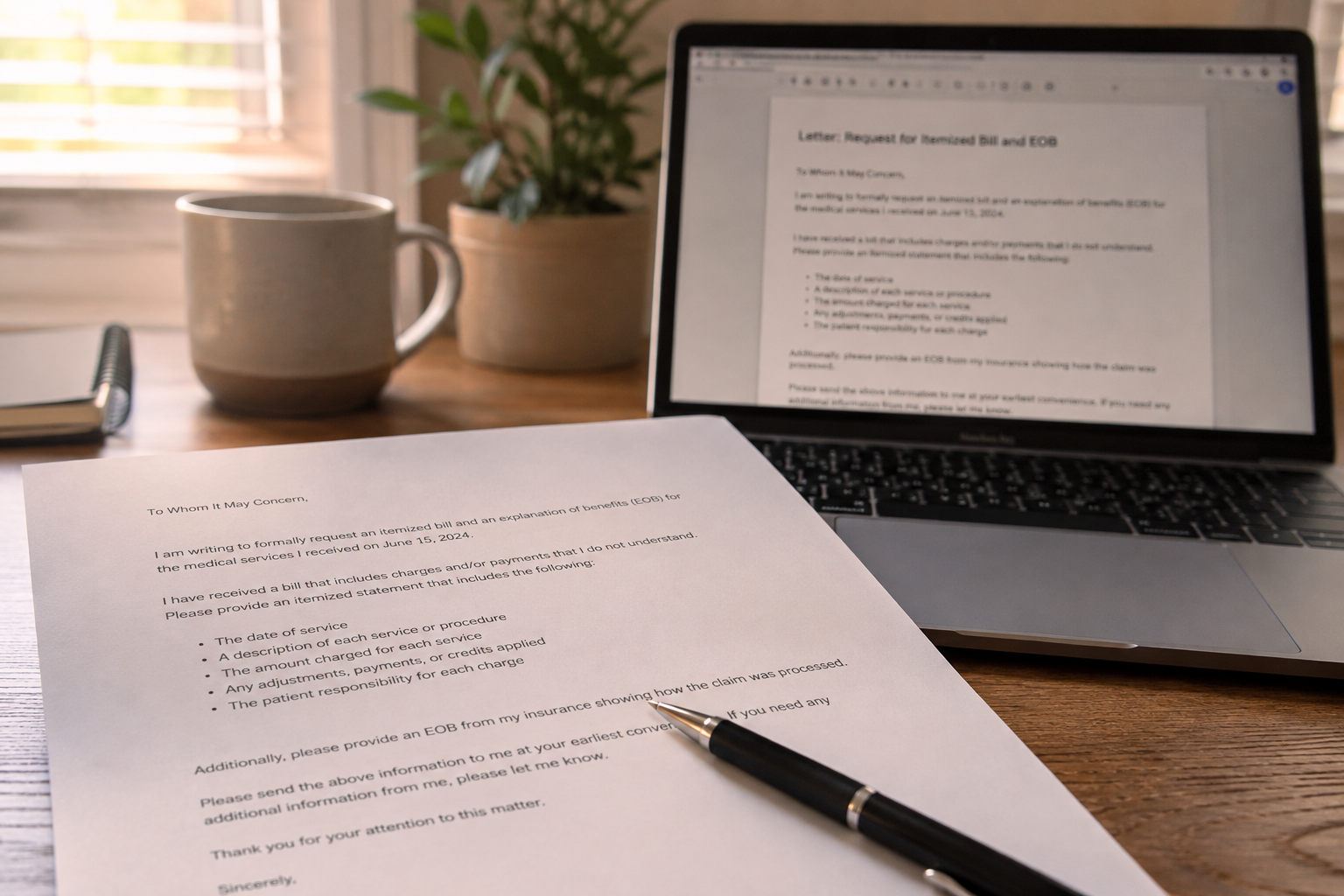
Phone Script vs. Email: What to Send Where
Both channels work, but they’re not interchangeable, and picking the wrong one for your specific situation just costs you time you didn’t need to lose.
| Phone call | Email / patient portal | |
|---|---|---|
| Best for | Prompt-pay discounts, urgent balances near collections | Charity care applications, anything needing documentation |
| Speed | Often resolved the same day | Typically several business days for a response |
| Paper trail | Weak — take your own notes right after hanging up | Strong — automatically dated and saved |
| Escalation | Easy to ask for a supervisor mid-call | Slower — usually needs a follow-up message |
| Best AI use | A short script you glance at while talking | A polished, complete letter you paste in close to as-is |
If you’re calling, keep the AI-drafted script nearby but don’t read it word for word off the screen — glance at it the way you’d glance at notes before walking into a meeting. If you’re emailing or using a patient portal, the AI draft can go over close to as-is, since tone matters less when there’s no real-time back-and-forth to react to.
Whichever channel you pick, write down the date, the name of whoever you spoke with, and exactly what they agreed to. Billing offices deal with real staff turnover. Your own notes are often the only record that a discount or payment plan was actually promised to you.

Common Mistakes People Make Negotiating Medical Bills With AI
Sending the first draft without personalizing it
An unedited AI script reads like exactly what it is — a template with a few blanks filled in. Swap in your real numbers, the real provider name, and one honest sentence about your situation before you send anything to anyone. If it still sounds stiff after that, the same edits that fix stiff AI writing anywhere else work here too.
Negotiating off the summary bill instead of the itemized one
The summary shows a single total. The itemized bill shows the $340 “facility fee” you never noticed sitting three lines down. You can’t dispute a charge you haven’t actually seen in writing.
Assuming charity care is only for people without insurance
It isn’t, and this assumption alone stops a lot of eligible people from ever applying. A high-deductible plan can leave an insured patient owing far more than they can realistically pay, and many hospitals evaluate total financial hardship rather than insurance status alone.
Accepting the first “no” as final
The person who answers the phone rarely has the authority to approve a meaningful discount on their own. Politely asking for a supervisor, and doing it more than once if the first one can’t help either, is often the actual step that gets a bill reduced.
Paying immediately out of anxiety, before checking eligibility
Refunds for approved charity care are technically possible after you’ve already paid, but the process is slower and far more paperwork-heavy than getting the timing right the first time. If you have any real doubt about your eligibility, ask before you pay, not after the fact.
FAQ
Can you actually negotiate a medical bill down?
Yes. Hospital list prices are rarely what insurers or Medicare actually pay, and billing offices routinely offer prompt-pay discounts, payment plans, or bill corrections once patients ask directly. It doesn’t work every single time, but asking costs nothing and often gets at least a partial reduction on a bill you’d otherwise pay in full.
What’s the fastest way to get a hospital to lower a bill?
Offering to pay a meaningful lump sum immediately is usually the quickest path, since advocates report 15% to 20% prompt-pay discounts are fairly common practice. If you can’t pay in full right now, a specific, documented dispute over an incorrect charge tends to be the next-fastest route to a real reduction.
Do you need to be uninsured to qualify for financial assistance?
No. Nonprofit hospitals generally evaluate your total financial situation, not just your insurance status, and patients with insurance — especially those on high-deductible plans — can still qualify for partial or full charity care if their household income falls within the hospital’s published thresholds.
How long do you have to apply for hospital charity care?
Federal rules generally give you at least 240 days from your first billing statement, not from the date of your actual visit, and many hospitals will accept applications even later than that, including after a bill has already gone to collections. It’s almost always worth applying, even if you assume you’ve missed the window.
Should you pay a medical bill before or after negotiating?
After, whenever that’s realistically possible. Once you’ve already paid, getting money back through a retroactive charity care approval is possible but noticeably slower and more paperwork-heavy. Check your eligibility and send your negotiation script or hardship letter before you send any payment.
Can AI actually call the hospital or negotiate on your behalf?
No, and it’s worth being wary of anything that claims otherwise. AI can draft the script, translate your paperwork, and prep you for likely pushback, but the actual phone call, the documents, and the final agreement still all go through you. Treat it as a fast, capable writing assistant, not a stand-in negotiator who handles the hard part for you.
The number printed on a medical bill is a starting offer, not a verdict — and once you treat it that way, learning to negotiate a medical bill with AI stops feeling like a trick and starts feeling like basic paperwork hygiene. Pull the itemized bill, run it through the prompts above, and send something specific before you send a payment. The bill doesn’t shrink on its own, but it rarely stays the same size once you actually ask.
It’s a small, personal version of a bigger habit worth building: letting AI quietly handle the parts of running your life, or your business, that used to eat a whole afternoon. For more of this kind of practical, no-hype AI-for-life guidance, browse our Everyday Life section.
AI Without the Hype · The Complete Series
The Complete No-Hype Guide to Claude
10 books · 693 pages · 450+ copy-paste prompts for writing, business, research, and everyday tasks like the ones in this article — every prompt verified, every verdict earned, zero filler.
$190 $47 · Save 75%
Get all 10 books →This article is educational information, not legal, medical, or financial advice, and isn’t affiliated with any hospital, insurer, or the providers named in it. Every hospital’s financial assistance policy is different — confirm your specific rights and deadlines directly with your provider or a licensed billing advocate. LookToAI is an independent, unofficial guide and is not affiliated with Anthropic, OpenAI, or Google.
Enjoyed this? Steal the 10 prompts I actually use.
The No-Hype AI Starter Kit — copy-paste prompts, a model cheat-sheet, and a 7-day plan. Drop your email and it's yours instantly.
No spam. Unsubscribe anytime.